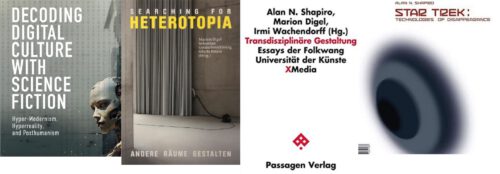
Alan N. Shapiro
media theory,
science fiction theory,
future design research

-
The Cage, The Menagerie
The Cage was the first of two pilot episodes produced for The Original Series. It was filmed at MGM Studios in December 1964 and delivered to NBC’s executive offices in New York in February 1965. It was first shown to the public at the 1966 World Science Fiction Convention in Cleveland.
-
Star Trek: First Contact
It is the seventh decade of the twenty-first century, our future and Star Trek’s past. Only an act of great heroism can save a dying civilization. A global nuclear war, the Third World War, instigated by the bellicose Eastern Coalition (ECON), has taken place in the fifties. We are ten years into its aftermath.
-
How the Transporter Really Works
Over the decades, the copious science fictional “explanations” of how Star Trek’s beaming technology really works, or might some- day be able to work, have undergone dis- cernable paradigm shifts. The original notion was that of the dematerialization-rematerialization, matter-to-energy conversion and back physical transporter.
-
Darmok
After Captains Picard and Dathon are transported to the isolated world’s surface, the Tamarians use an ionospheric particle scattering field to block all attempts by Enterprise-D technicians to beam Picard back from the planet, and to make any communication with the two men impossible.
-
Arena
In the pre-Klingon and pre-Borg Original Series episode Arena, Captain Kirk is involved in a one-on-one duel against an antagonistic and radical alien Other, the Gorn commander. The episode is entitled Kaijû Gôn tono Taiketus, or Duel With the Monster Gorn, in Japanese dubbing.
-
Amok Time
On their way to Altair VI (in the solar system visited by Forbidden Planet’s United Planets CruiserC57D) to represent the Federation at a postwar presidential inauguration on a rebuilding world, the Enterprise senior officers must contend with an increasingly irritable and violent Mr. Spock.
-
All Our Yesterdays
Kirk, Spock, and McCoy beam down to the planet Sarpeidon, the only natural satellite of a star, Beta Niobe, which is going to explode as a supernova. Although it has been previously established that a “civilized humanoid species” dwells on the planet, Enterprise sensor scans strangely indicate that there is no intelligent life remaining anywhere on that world.
-
A Taste of Armageddon
The Enterprise is en route to the NGC 321 star cluster to try to establish diplomatic relations with Eminiar VII, the most technologically advanced planet in the area. More than fifty years earlier, the Federation starship U.S.S. Valiant was listed as missing in space after it transmitted a report from Eminiar and then vanished.
-
L’importance de Baudrillard pour l’avenir
L’un des meilleurs commentateurs de Baudrillard est Gary Genosko, l’auteur du Baudrillard and Signs, un livre qui place Baudrillard dans le contexte de la sémiotique et de la pataphysique. Genosko écrit: «Baudrillard est l’inventeur d’un langage sophistiqué décrivant les capacités de simulation les plus avancées des systèmes d’information.»
-
Daniel Defoe’s Robinson Crusoe
The basic situation of Robinson Crusoe’s early life was that of a young man who did not want to get a job. Robinson was born in the year 1632, in the city of York, of a good family. His father was a successful businessman, a trader in “merchandise.”
-
Cultural Citizenship in Contemporary America
In one terminology, cultural citizenship is a process which takes place in the context of a specific historical relationship between the individual and the social. In what may be the most highly socialized society that ever existed, Americans tend to almost completely deny that there exists a social or cultural realm.
-
Charles A. Lindbergh’s The Spirit of St. Louis
We think of Lindbergh as the far-right most prominent speaker at rallies of the “America First” movement in the early 1940s, an isolationist precursor of the unilateralist Donald Trump and his horrible MAGA movement. I present here an alternative existentialist view of Lindbergh’s pioneering 1927 flight.
-
“Outer space is a blank canvas” — Interview with Forty Two Magazine
Wir alle leben Science-Fiction, und die Zukunft ist utopisch – zumindest könnte sie das sein, würden wir sie uns bloß richtig vorstellen? Im Gespräch mit 42 Magazine argumentiert Alan N. Shapiro dafür, dass wir verstehen müssen, dass Science-Fiction keine Zukunftsmusik ist und wir uns letztlich von der Idee verabschieden müssen, alles wissen zu können.
-
Body, Self, and Code in Hypermodernism
This is the text of the speech that I gave at the Schaubühne theater in Berlin on 23. February 2020, at an event in the “Streitraum” series led by Carolin Emcke.
-
How to Regulate the Media when they are ubiquitous and have gone viral: from utopian science fiction to practical European policy
This is the text of the keynote speech that I gave at the European Union conference “Pluralism and Responsibility: Media in the Digital Society” in Berlin on July 7, 2020. I was invited to speak by Monika Grütters, the German Federal Government Commissioner for Culture and the Media.
Categories