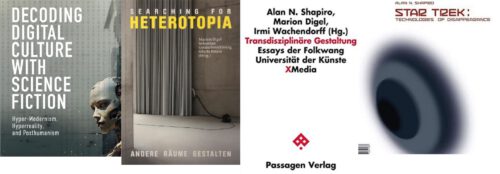
Alan N. Shapiro
media theory,
science fiction theory,
future design research

-
The Car of the Future, more sketches, by Nick Pugh
All images © Copyright Nick Pugh and Alan N. Shapiro, 2010
-
Baudrillard’s Second Life, by René Capovin
Fashion in the modern sense presupposes the becoming-autonomous of interaction, and is linked, in particular, to the communications of the mass media. In a society differentiated by functions, in fact, there is no one class or group that can impose its own “taste.” Everyone must conform their own taste to the information of all others.”
-
Georges Bataille and Epistemology
Bataille’s Theory of Religion and The Accursed Share have been read by generations of Marxists, deconstructionists, and Baudrillard the man himself in economic terms. But, in the current situation of virtuality, it is most interesting to read these texts from an epistemological point of view.
-
Around the Town (a Sports Gambling story), part 1 of 4
As they went inside Grand Central Station, Moe and Siggy saw hurried commuters moving with tunnel vision, not looking at the homeless. The bag ladies and street people would put a damper on one’s day. Past the panhandlers and cup rattlers, the squeegee people, and the Monte dealers, the determined nine-to-fivers kept moving.
-
The End of Homo Oeconomicus
Da der Mensch ein lebendiges Wesen ist, müssen wir unser Konzept vom Menschen ändern, vom Homo Oeconomicus zu einer Idee des kreativen Menschen, wie der Physiker-Philosoph Hans-Peter Dürr sagt. Wie alle lebendigen Organismen verfügt auch der Mensch über eine Wachstumsfähighkeit.
-
Dance and Digital/Virtual Technologies, by Jaana Parviainen
Dwelling in the virtual sonic environment: Phenomenological analysis of dancers’ learning processes in working with the Embodied Generative Music interface. “We must admit that the sound, of itself, prompts rather a grasping movement, and visual perception the act of pointing.” (Merleau-Ponty)
-
Sketches of the Car of the Future, by Nick Pugh
Here is a sampling of 8 of the 34 sketches made by Nick Pugh for the concept of the Car of the Future as a shapeshifter. All images © Copyright Nick Pugh and Alan N. Shapiro, 2010.
-
The Car of the Future is a Virtual Reality Game Platform
Paul Virilio is a French theorist of technology whose work has focused on architecture, art, transportation, war, urban planning, and the cinema. Virilio’s central concept is speed. He is also a theorist of accidents and crashes.
-
The Car of the Future is a Shapeshifter, by Nick Pugh
Like Odo in Star Trek: Deep Space Nine, the Car of the Future is a shapeshifter. ‘Space is the final frontier’ and that is true on earth as well. Real estate is fundamentally limited by the surface area of the planet. More of it is not currently in production.
-
A Critique of the Idea of Neutral Language, by Marc Silver
In Arguing the Case, Marc Silver shifts the ground in original ways. He is not content to “deconstruct” the discourse founding the disciplines he studies – political, legal, scientific, literary, and psychoanalytic. He reveals the rhetorical, logical and philosophical rules as well as the paradoxes and aporias, which sustain the disciplines he illuminates.
-
Towards a New Computer Science: Instantiate a Much Richer Software Instance
In this group of 5 coding projects, the core operations of the Limerick Metric will be developed. Where does the New Computer Science stand in relation to the prevailing software development paradigm of Object-Orientation (UML, C++, Java, etc.) ? The New Computer Science both respects and radicalizes Object-Orientation.
-
The Answer to the Question of Artificial Life
Artificial Life is an emerging movement within computer science which has as its goal to make software that is more “alive” rather than mechanistic. This goal is similar to our goal. However, Artificial Life has overlooked something very important and obvious. It has overlooked that “vitality” already exists in knowledge fields and in creative arts.
-
Inscribe Philosophy into the Heart of Computer Science
There are many individuals in the technology and cyberculture communities who are not just “engineers” or techie programmers. They are already working to bring software together with art and sociology. These people are our friends and allies. However, in their projects, they are working two or three levels removed from the core of computer science.
Categories