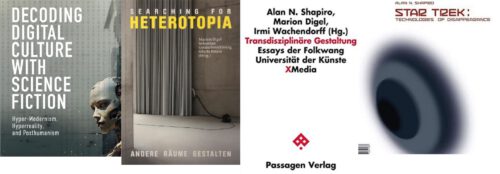
Alan N. Shapiro
media theory,
science fiction theory,
future design research

-
Towards the Internet of Creators, by Alan N. Shapiro
We don’t yet have an Internet where the creator of a photograph, a video, a piece of music, a segment of software code, a digital artwork, a journalistic piece, or a writerly composition is identified by a special authentication signature or a certificate of ownership.
-
Transdisciplinary Code and Objects, by Alan N. Shapiro
In Impossible Exchange, Baudrillard separates his system of thought from ‘neo-Marxist critical theory’, which, on the whole, is also a subject-centered perspective (although one could definitely find an ‘object-centered perspective’ in the original texts of ‘Frankfurt School’ thinkers like T.W. Adorno).
-
The development of New Music theory and philosophy with focus on the American composer John Cage, by Marit Trantel
Cage was one of the most important composers of New Music and helped to revolutionise the concept of traditional classical music entirely. Important for this revolution was also the philosophy that stood behind his music and which is intricately linked to his “compositions“.
-
“Nature Disappears Beneath Our Words and Images”: Nicola Toffolini interviewed by Alan N. Shapiro
That makes me think of two different meanings of the word ‘performance’. In the theatre, you are doing the performance. In your artwork, the technical specialists who construct the artefacts that you have designed are performing the artwork, in the sense that they are implementing the design.
-
“I Bring Philosophy and Biotechnology into the Sphere of Art”: Polona Tratnik interviewed by Alan N. Shapiro
You use the phrase “engagements in culture” at your website to describe some of what you do. Is this idea a way of connecting together your two careers as an artist and as a professor of media culture and cultural studies?
-
How to Take Back Our Freedom in the Surveillance Society, by Alan N. Shapiro
We need to go beyond Foucault-, Orwell-, and Huxley-inspired models of how contemporary quasi-totalitarian systems of social control work. Individual freedom right now is in big trouble. American hyper-reality, hyper-work, hyper-consumerism, hyper-communication, and hyper-eating today strike me in so many aspects as being systems of mutual- and self-surveillance.
-
“Die Software der Zukunft,” new book by Alan Shapiro
My new book Die Software der Zukunft was just published by the Walther König Verlag in Cologne. Mit seiner “Software der Zukunft” pladiert der Informatiker und Medientheoretiker Alan Shapiro für eine partizipatorisch realisierte Neuausrichtung der Informatik.
-
Natural Language Processing, by Matthieu Lion
My project consists of research into Natural Language Processing, including developing in Java and the RebeccaAIML platform a conversational flow interaction between a human and a software. I will integrate aspects of the SuperObjects paradigm.
-
Sorcerer’s Apprentice Video Game for the Android Smartphone Platform, Programmed in Java, by Sitha Reis
I programmed a Sorcerer’s Apprentice Video Game for the Android smartphone platform in Java. I used the Eclipse Java Integrated Development Environment. The video game is very graphics-intensive, and I used the OpenGL toolkit, which is the industry standard for high performance graphics, from games to virtual reality, mobile phones to supercomputers.
-
Generating Sound Art from Java Code, by Anna Semykina
I want to generate sound from mathematics. I want to read a graphics file pixel by pixel, get the RGB values, and generate sound from that. In a second iteration, I will move to a coded schema layer of interpretation between the image and a categorization of images according to an image library or archive.
-
AnatoMe Hypermedia System, by Magdalena Fournillier
„AnatoMe“ ist ein Programm / eine Applikation zur illustrativen Darstellung der morphologisch fassbaren, krankhaften Veränderung der menschlichen Organe.
-
Portfolio, by Vanessa Ramster
My project is HTML- and JavaScript-based, and builds upon the OVERFLOW project, a site template designed by AJ for HTML5 UP. It’s fully responsive, and built on skelJS.
-
Software Code as Expanded Narration, by Alan N. Shapiro
Computer programming is about algorithms, formal logic, precise reasoning and problem solving. As such, it would appear to have little to do with what we call creative expression. The logical act of programming and the self-expressive act of creativity would seem to be polar opposites.
-
Virtual and Physical Geometric Objects with Processing, by Christos Voutichtis
I want to use the creative coding environment Processing to experiment with and understand the crossover between virtual geometric objects on the screen and physical geometric objects to be generated by 3D printers and other material production devices for trans-architectural art projects.
-
Material Grove 3-D Modeling with Rhinocerus and Grasshopper, by Johannes Wöhrlin
Using the Rhinocerus 3-D modeling tool for designers and the Grasshopper graphical algorithm editor add-on, I created new form generators. I wanted to write code in Python to gain parameterized control over generative algorithms and shape creation.
Categories