
Alan N. Shapiro
media theory,
science fiction theory,
future design research


-
Interview with Artist Network Theory
AXELLE: We met in a media theory course you gave in Lucerne at the HSLU where I was a student in the masters design program. I was struggling to legitimate my position as an artist entering the field of design in a program which at the time had no face, no position, and no theory.
-
Some Visions of Post-Capitalism
The book that I have read about Marx that most inspired me was Marx’s Theory of Alienation by the Hungarian Marxist philosopher István Mészáros, published in 1970. Mészáros argues that the first full-fledged elaboration of Marx’s philosophical system is to be found in the theory of alienated labour of the Economic-Philosophical Manuscripts of 1844.
-
From mass advertising to personalized advertising: the Billboard Cage Project of Christos Voutichtis
The billboard is like a theatrical stage. It is an exhibition space, a seductive or informative representation of a product or service or venue, or a simulation drawing attention to itself and becoming its own hyper-reality. It is a large advertising structure on the side of the highway or in the middle of the city.
-
Is Trump a Fascist or is He the Parody of Fascism?
This is the text of my speech at the virtual conference “Trump, Television and the Media: From Drama to Fake News to Tweetstorms” organized by London Metropolitan University which took place on 30-31 October 2020.
-
From Sociology to Media Studies to Software Studies, part one
I disagree with Kittler’s statement that there is no software. In my view, just because the kernel or center of computing is rational and computational and digital-binary does not mean that all the other layers, languages, and interfaces of the system, and which surround the kernel, must obey or follow that logic.
-
From Sociology to Media Studies to Software Studies, part two
Kittler opposes the so-called discourse analysis of the study of media practiced in much of the humanities, which he sees as deriving its methods from hermeneutics and literary criticism. He instead advocates a technical materialism of data storage devices, data transmission, processors, automatic writing systems, and so forth.
-
The Simulacra of Public Space: the work of Christos Voutichtis, by Alan N. Shapiro
Der Wohnraum und das Handy selbst werden heute als Kommandozentralen begriffen, als Terminals, ausgestattet mit telematischer Macht, das heißt mit der Möglichkeit, alles über Entfernungen hinweg zu erledigen. Der ordinäre Mensch hat jetzt die Macht, die militärische Generäle früher hatten. Gleiches gilt für den öffentlichen Raum.
-
Technological Anarchism, by Alan N. Shapiro
My intention is to write a book developing the transdisciplinary concept of Technological Anarchism as an optimistic, normative, heterotopian (a term of Michel Foucault) idea of a near-future and open-ended social, logistical, and economic system of Post-Scarcity and Post-Capitalism.
-
Science-Fiction-Replikatoren: Additive Fertigung und die Ökonomie der Zukunft, von Alan N. Shapiro
This was the text of my keynote speech at the conference of the Swiss Manufacturing Association in October 2018. Sozialismus ist schiefgegangen. Kapitalismus muss sich verändern. Der europäische Kapitalismus hat Angst davor, von Asien überholt zu werden. Wie also sieht die Vision für den europäischen Kapitalismus aus, um sich erfolgreich weiter zu entwickeln?
-
Baudrillard and the Situationists, by Alan N. Shapiro
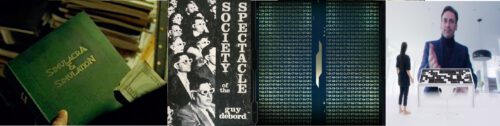
What are the similarities and differences between the Situationist theory of hyper-capitalism and consumerist media culture – the theory of “the society of the spectacle” – and Jean Baudrillard’s theory of image, media and consumer culture – the theory of simulation, simulacra, virtuality, hyper-reality, Integral Reality, and “the models and codes precede the real”?
-
Mobility and Science Fiction, by Alan N. Shapiro
The term “digitalization” accurately describes the technologies of the past several decades which we already have, like the automation of the office and other work processes, and Personal Computers and the Internet. The next wave of “futurist” technologies is better described with a term like the Fourth Industrial Revolution or self-aware technologies.
-
Gestalt-Ideas at the Interface between Theory and Practice, by Alan N. Shapiro
The information society, the hi-tech society, the society of digital culture, the society of universal networked connectedness – where the answer to every question is seemingly available at our fingertips, by little scrolls of, and little finger inputs into, our smart devices – has brought many benefits.
-
Philosophie, Science und Ökologie: Whitehead und Merleau-Ponty über den Begriff der Natur, von Alan N. Shapiro
Vor etwa zehn Jahren begann ich mich intensiv für Kunstwerke und Kunstinstallationen zu interessieren, die Wissenschaften und Technologien in ihrer Konzeption und Ausführung mit einbezogen: Medienkunst, Electronic Art, Computerkunst, Videokunst, Bio Art, transgenic art, robotics art, telepresence art, ecosystems art und virtuelle Kunst.
-
Fiktion ist der Schlüssel zu kreativen Lösungen, von Alan N. Shapiro
Die Beschäftigung mit Fiktionen und Utopien ist nicht gerade en vogue. Erfolgreiche Transformationsbewegungen haben jedoch als Ausgangspunkt, dass ein anderes als das gegenwärtige Leben gewünscht wird oder vorstellbar ist – statt wie zur Zeit eine Hyperrealität als Zukunft zu akzeptieren.
-
Der Turing-Test und John Searles Gedankenexperiment vom chinesischen Zimmer, von Lulu Zhao
Durch die Entwicklung der Informatik und der Kognitions-Wissenschaft im 20. Jahrhundert wurde die traditionelle Philosophie des Geistes Gegenstand wissenschaftlicher Erforschung. Diese Wandlung ist dabei auf eine Computer-Analogie des menschlichen Gehirns zurückführen. Als Ergebnis dieser Paradigmenwechsels entstand das Thema der künstlichen Intelligenz.
Categories