A New Computer Science is Underway: Alan N. Shapiro interviewed by Anja Wiesinger
republished in the Berlin fashion print magazine Style and the Family Tunes: Pop Cultural Views on Global Issues, Fall 2010 (in German and English)
American philosopher and veteran software engineer Alan Shapiro reflects on computer science in relation to the history of ideas it originated from.
During a recent visit to Berlin, Shapiro met up with META to share his vision of a pragmatic-utopian enterprise project which operates on friendship and radical program code.
Wir arbeiten 40 Stunden die Woche. Als primitiv und barbarisch würde das einer höher entwickelten Zivilisation vorkommen, behauptet Alan Shapiro. Der amerikanische Philosoph und Software-Ingenieur plädiert für eine neue, utopisch-pragmatische Arbeitsethik aus kreativen Spiel und individueller Freiheit. Er sinnt über Denker und Informatik, McDonaldisierung und Disneylandifizierung, das Klonen von Wissenschaftlern, den Feminismus in “Star Trek” und warum wir von Tänzern lernen können.
We work a forty-hour week. This would be considered barbaric and primitive for more advanced civilizations than ours, maintains Alan Shapiro. The American philosopher and software engineer advocates a new utopian-pragmatic work ethic consisting of creative play and individual freedom. He mulls over information technologies, philosophers, McDonaldization and Disneylandification, the cloning of scientists, feminism in “Star Trek” and the lessons we could learn from dancers.
META: In your talk at General Public in Berlin, you said that, since you are an American, you would pursue the route of business to achieve your ideas. Reading your text on Cultural Citizenship at the International Journal of Baudrillard Studies (IJBS), you criticize American culture for being too driven by money and the egoistic individualism which is an outcome of capitalist society. This seems contradictory to me.
Sie sagten einmal, dass Sie als Amerikaner Ihre Ideen durch die Gründung eines Unternehmens verfolgen würden. Auf der anderen Seite kritisieren Sie an der amerikanischen Kultur den großen Stellenwert, der dem Geld eingeräumt wird und den egoistischen Individualismus, der sich aus der kapitalisticschen Gesellschaft ergibt. Für mich ist das ein Widerspruch.
Alan Shapiro: Das ist quantenphysische Soziologie, eine doppelte Realität, kein Widerspruch. Wir werden die Welt nicht mit einer kommunistichen Partei oder einem anarchistischen Sturm auf die Barrikaden ändern, deshalb schlage ich eine neue Interpretation des Marxismus vor. Organ des Wandels wäre eine Art Apple oder Google, radikalisiert durch Kunst, Philosophie und kritische Sozialtheorie. Wäre solch ein pragmatisch-utopisches Unternehmen in Amerika tätig, würde es die Verbindung mit all den wunderbaren amerikanischen Dingen suchen, über die ich schreibe: Baseball, der Wüste, dem Glücksspiel in Las Vegas, Fast Food, nach dem man sich die Finger leckt, Schnappschüssen von den Niagarafällen, Autofahren im semiotischen Brachland des Goldenen Kalbs, Neongöttern, mit Einkaufsmeilen, Parkplätzen, Wal-Marts, der Hitzewelle, Fahrten im Greyhound-Bus – alles verstanden und beschrieben in einer ganz bestimmten Art und Weise – das ist die positive Seite Amerikas.
Alan Shapiro: It’s quantum physics sociology, a double-reality, not a contradiction. In my two essays on America at IJBS (the other one is “Re-discovering the Baudreality of America”), in my writings on baseball and casino gambling and American Slang, in my book on Star Trek, in what I wrote about Charles Lindbergh’s courageous flight, I am laying the groundwork for a new American Studies. American Studies, by the way, is a promising academic field in Germany. I gave a lecture recently in that department at the University of Oldenburg. The founding works of the new American Studies are Alexis de Tocqueville’s “Democracy in America” and Jean Baudrillard’s “America” (and perhaps also the book by Bernard-Henri Lévy). My double-approach to America of critique and celebration has its precedent in both of these great inspiring works. Both authors criticize American hyper-capitalism and hyper-conformity in the same way that I do. Yet they both see a great hope for human liberation in another dimension of America. Star Trek, baseball, the desert, gambling in Las Vegas, fast food finger lickin’ good, Slang I’ve no idea what you just said, film as life and life as film, photo snapshots of Niagara Falls, Manhattan skyscrapers engineered by my father Murray Shapiro, driving in the semiotic wasteland of the golden calf neon gods, smash hits on the Chrysler stereo, strip malls parking lots Wal-Marts, heat wave, riding the Greyhound bus, heroic deeds of aeronautics and astronautics, new technologies up the kazoo – all understood and written about in a certain way – this is the positive side of America. DeLillo, Auster,Pynchon, Boyle, and Jason Starr. Philip K. Dick and Samuel R. Delany. I start with what Baudrillard intuited about America, and expand on that.
SLOWLY I TURNED… STEP BY STEP… INCH BY INCH…
NIAGARA FALLS!
Regarding what I said about business at the two Berlin events organized by Shintaro Miyazaki and Andreas Lange, respectively, one should not take it too literally. Everything that I say and write is based on the philosophy of deadpan humour. Peter Sellers. I’m completely serious, on the level, but at the same time not. This is my sincerity. That’s how you deal with a world of Lies, Inc.
When I met Baudrillard at the ZKM (Center for Art and Media) in Karlsruhe in 2004, he told me in a whispering tone that his work is indeed about changing the world, not just criticizing it. And I love him like a father, in the name of the father I proceed, so it’s like he stung me like a bee that day, and in a way now I’m stuck with this responsibility. Unfortunately for me, Lyotard, Lefort, Castoriadis, Derrida, Nancy, Habermas, and Kroker all said similar things to me when I had conversations with them. We aren’t going to change the world with a Communist Party or an anarchist uprising on the barricades, so in my essay “Play Don’t Work in a Pragmatic-Utopian High-Tech Enterprise,” I propose a new interpretation of Marxism. The agency of change would be a sort of Apple or Google radicalized by art, philosophy, and critical social theory. If such a pragmatic-utopian company operated in America, it would then want to connect with all those ecstatic things about America that I write about and engage with: the enumeration listed and iterated above.
AS: Die beiden grundlegenden Prinzipien des radikalen pragmatisch-utopischen High-Tech-Unternehmens sollten Freundschaft und Nicht-Arbeiten sein. Es gibt hundert unterschiedliche Arten von Freundschaft, und so kann man noch nicht genau sagen, was das bedeuten wird. Man wird damit experimentieren müssen und es in der Praxis herausfinden. Die Einstellung gegen die Arbeit wie sie sich heute darstellt, ist von fundamentaler Bedeutung. An unserer Arbeitssucht und unserer strukturellen Unfähigkeit, Künstlern und anderen Kreativen ein angemessenes Leben zu ermöglichen, ist etwas grundlegend falsch. Doch ich meine ganz sicher nicht, dass wir überhaupt nicht mehr arbeiten sollen. Wir sollten Arbeit und Vergnügen auf neue Art miteinander verknüpfen, viele Menschen tun das bereits. Ich selbst arbeite ziemlich hart.
AS: I wrote in “Play Don’t Work” that the two basic principles of the radical pragmatic-utopian high-tech enterprise should be friendship and “not working.” There are a hundred different levels of friendship, so who knows exactly what that will mean, it has to be experimented with and figured out in practice. Being against work as it is constituted today is fundamental. Something is deeply wrong with our workaholism, and our structural inability to provide artists and other creative people with a decent living. But I certainly don’t mean that we should not work at all. We should integrate play and work in a new way, as many people already do, and as my daddy taught me. I am quite a hard worker myself.
AS: Es wäre also ganz anders als unser Business-as-usual. Sicher ist das eine weit hergeholte utopische Vision. Doch zugleich scheint sie historisch möglich zu sein. Die Chancen, dass sie sich verwirklicht, stehen – so hat es mir Mr. Spock jüngst berichtet – bei exakt 1 zu 7.643. Aber die Mets haben ja auch 1969 die World Series gewonnen.
AS: So it would be very different from business-as-usual. It’s a far out utopian vision to be sure. Yet at the same time, it seems to be in the historical cards, it seems to be preparing itself to happen, to dump a phrase-construction from the non-English portion of my mind. The odds against it happening, as Mr. Spock recently reported to me, are exactly 7.643 to 1. Yet the Mets won the 1969 World Series.
META: Sie plädieren für eine Arbeitsethik, die an den ersten New-Media-Boom der 1990er erinnert. Zehn Jahre nach dem Crash der digitalen Technologien kündigen Sie die nächste Welle an. Was wird anders sein als früher?
META: You suggest a work ethic that is reminiscent of the first new media economic boom of the 1990s. Ten years after the crash of digital technologies, you say that there is a next wave coming. What will be different than before?
AS: No, I haven’t said that at all about work ethic. With all their progressive thinking and practice in certain areas, no major technology company has ever questioned the Protestant work ethic that underlies our cutural and economic system. Since I have seriously read Karl Marx, Max Weber, and Jean-Paul Sartre, it falls to me to be the guy who’s questioning it. Almost every company in the world today forces its white-collar employees to work well in excess of 40 hours a week. This is primitive and barbaric, as advanced alien civilizations encountered by Captain Kirk or Captain Picard’s Enterprise would say.
AS: Weil in den Bereichen der neuen Medien und neuen Technologien die Kreativität eine entscheidende Rolle spielt, glaube ich, dass die Unternehmen hier einen völlig anderen Ansatz verfolgen könnten: Qualität statt Quantität, Kreativität, Spiel, individuelle Freiheit und eine Vielzahl unterschiedlicher Aktivitäten könnten auf eine ganz neue Art und Weise mit der Produktivität in Bezug gesetzt werden, stat davon auszugehen, dass diese nur durch Schufterei erreicht werden kann. Auch meine Perspektive der virtuellen Realität als Traumwelt zu betrachten, in der man der konventionellen physischen, körperlichen und raum-zeitlichen Realität entfliehen konnte. Nun können wir mit einem anderen Ansatz experimentieren, dem der Verkörperung. Das ist einer der Gründe für mein großes Interesse an der sozialen Choreografie, deshalb denke ich, dass Tänzer und Sportler wichtig sind für unser neues Verständnis des Virtuell-Realen. Virtuelle Technologien sollten die Realität verbessern – nicht sie ersetzen oder zur Flucht aus ihr dienen. Wir wollen keine Konsumgesellschaft von Couch-Potatoes.
AS: Since new media and new technologies are essentially about creativity, I believe that it is possible for a company to take a totally different approach: quality not quantity. Creativity, play, individual freedom, and variety of activities can be worked up into a new connection with productivity. Instead of assuming that only drudge work can achieve productivity. My perspective on virtual reality is also different from ideas about virtual reality that were widely articulated in the 1990s.
I’M VERY INTERESTED IN SOCIAL CHOREOGRAPHY — DANCERS AND ATHLETES ARE IMPORTANT FOR OUR NEW CONCEPTION OF THE VIRTUAL-REAL
META: In Ihrem Essay “Cultural Citizenship in Contemporary America”, sprechen Sie über das Überflussparadoxon. Sehr verkürzt dargestellt beeinträchtigt dies die Zufriedenheit des Individuums in der Gesellschaft. Soziale Erfolge verlieren ihren Wert, sobald zu viele Menschen dieselbe Erfahrung machen. Was wollen Sie uns damit sagen? Wenn man das Konzept auf das Gebiet der Technologie überträgt, ist es dann nicht eine Frage der Skalierbarkeit? Je komplexer ein System, desto gewaltiger die Gefahr, dass es zu Schäden kommt…
META: In your essay “Cultural Citizenship in Contemporary America”, you talk about the paradox of affluence. Very briefly, it affects the satisfaction of individuals within society. Something that is considered a social advancement loses its value once too many people share the same experience. What is the point that you are trying to make? Translated into the realm of technology, isn’t this a matter of scalability? The more complex a system is, the greater the danger becomes that it is going to break…
AS: Ich habe das “Überflussparadoxon” von Ökonom Fred Hirsch übernommen, er führt es in seinem Buch Die sozialen Grenzen des Wachstums aus. Dabei geht es um die sozialen oder durch die Umwelt bestimmten “Nutzungsbedingungen” aller Dinge oder Erfahrungen, die die Menschen begehren. Je mehr Menschen eine gewisse Ebene an beruflicher oder fachlicher Bildung erreichen, desto weniger Wert hat diese Bildung im Wettstreit um Arbeitsplätze. Je mehr Menschen Häuser in den Vororten kaufen, desto stärker verändern sich diese Vororte und weisen allmählich alle aus den Städten bekannten Probleme und Schandflecken auf. Die “Nutzungsbedingungen” verschlechtern sich, je weiter verbreitet die Nutzung ist. Die Suche nach kultureller Staatsbürgerschaft (Cultural Citizenship) hat Grenzen und fließt in die Paradoxa der übermäßigen Nutzung ein.
AS: I took the “paradox of affluence” from the economist Fred Hirsch, his book “Social Limits to Growth” (a book from 1976, which happens to be the same year as the publication of Baudrillard’s major work “Symbolic Exchange and Death”). This is about the social or environmental “conditions of use” of any good or experience which people desire. The more people attain to a certain level of professional or vocational education, the less value that education has in the scramble for jobs. The more people acquire homes in the suburbs, the more the suburbs are transformed and gradually attract all the problems and blight of the city. The more tourists flock to a locality, the more that locality takes on the qualities of universal tourism and loses much of what it was. “Conditions of use” deteriorate as use becomes more widespread. The search for Cultural Citizenship has limits, and becomes involved in paradoxes of overuse.
AS: Wirtschaftswachstum ist wünschenswert. Wir müssen herausfinden, wie wir nachhaltiges Wachstum ermöglichen können, ohne den Planeten und uns selbst zu zerstören. Es ärgert mich, wenn Sozialkritiker und grüne Fundamentalisten sagen, sie seien gegen Wachstum. Das ist zu negativ. Ich bin gegen Wirtschaftswachstum in der Art und Weise, in der es heute gedankenlos in der herrschenden Variante des monopolistischen Kapitalismus praktiziert wird.
AS: Economic growth is desirable. We have to figure out how to sustain growth without destroying the planet and ourselves. It annoys me when social critics and green fundamentalists say they are against growth, that is too negative. I am against economic growth in the way that it is currently being mindlessly practiced by the ruling version of monopolistic capitalism.
AS: Was die Bedeutung und Herausforderungen der Skalierbarkeit angeht, haben Sie Recht. Dabei vollziehen wir den Schritt vom Nachdenken über das Problem der Überflussparadoxons zum Nachdenken über die Lösung. Wir hatten eine aristokratische Klasse von Müßiggängern, dann versuchten wir, den Wohlstand auf die Massen zu übertragen und endeten mit der McDonaldisierung und Disneylandifizierung der gesamten Gesellschaft. Die Frage ist also: Wie erreichen wir eine Massenkultur des Wohlstands, die nicht so verdummt ist wie die, die wir bisher geschaffen haben? Ein Aspekt der Suche nach einer Antwort ist paradoxerweise der, dass wir herausfinden sollten, was an McDonald’s und Disneyland positiv ist. Wir sollten sie nicht so schnell verdammen.
AS: You are right, Anja, about the importance of the challenge of scalability. This is switching from thinking about the problem of the paradox of affluence to thinking about the solution. We had an aristocratic leisure class, as Thorsten Veblen wrote about in his classic sociological work, then we tried to spread affluence to the masses, and we ended up with McHouses, and the McDonaldization and Disneylandification of all of society. So the question is: how do we achieve a mass culture of prosperity that isn’t so dumbed down like what we have built up so far? One aspect of searching for the answer is paradoxically that we should investigate what is positive about McDonald’s and Disneyland, and not be so quick to dismiss them.
META: Welchen Ansatz verfolgen Sie für eine neue Informatik?
META: What’s your approach towards a new computer science?
(TRANSFORMING COMPUTER SCIENCE INTO A HUMANITIES SUBJECT… that is what we must do.)
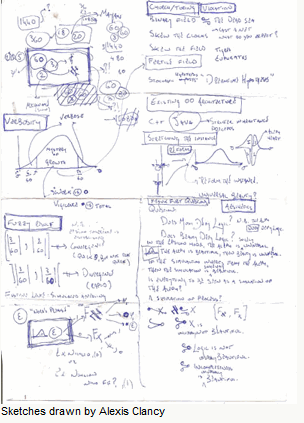
AS: Alexis Clancy and I have defined 22 concrete software development projects: code to be written primarily in Java and in an extension of Java, projects which, when taken together, would constitute the New Computer Science. We have written the architecture and design of these projects in a first iteration. The next step is to start writing the code and simultaneously deepen the design document. I’ve written a little bit of New Computer Science code already, but we would need capital investment from at least two sources before being able to go forward. We would have to be able to pay the programmers on the team.
AS: Ich habe an der Cornell University Ideengeschichte studiert. Dieses Studium ist die Basis meiner Bildung. Danach war ich 15 Jahre lang als Software-Entwickler tätig. Denn dachte ich über die Informatik im Kontext der Ideengeschichte nach und kam zu dem Schluss, dass die Informatik bisher keine über die des 17. Jahrhunderts hinausgehenden Ideen in Betracht zieht. Die sogenannte Wissenschaft der Informatik ist noch keine Wissenschaft. Bisher ist sie nur eine Computertechnik. Sie basiert auf der Philosophie und den wissenschaftlicen Methoden des 17. Jahrhunderts.
AS: I studied the history of ideas at Cornell University. That’s my core education. Then I spent 15 years as a practicing software developer. Then I reflected upon what computer science is in the context of the history of ideas, and came to the view that computer science has not yet really taken into account any ideas beyond the 17th century. So-called computer science is not yet a science. So far it is just computer engineering. It is based on 17th century philosophy and scientific method.
AS: Um aus den eigenen Ressourcen schöpfen zu können, erfolgt die Arbeit an der neuen Informatik in zwei Dimensionen. Eine Dimension ist das Code-Schreiben. Die andere Dimension ist das Projekt des umfassenden Überdenkens des gesamten Klassifizierungssystems oder der Wissenskategorien des Westens (beginnend mit der Trennung zwischen Natur- und Geisteswissenschaften). In der modernen akademisch-universitären Szene ist viel von Interdisziplinarität die Rede. Doch in einer wichtigen Hinsicht ist die Interdisziplinarität Heuchelei. Wenn die Katergorisierung des Wissens so obsolet ist, das angeblich interdisziplinarität erforderlich wird, dann ist in Wirklichkeit eine komplette Neuerfindung angemessener Wissenskategorien notwendig. Wenn wir, um wertvolles Wissen zu erlangen, mehrere Fachgebiete abdecken müssen, zeigt dies nur, dass wir in Wirklichkeit ein Großprojekt brauchen, um zu überdenken, in welche Kategorien das Wissen aufgeteilt werden sollte.
AS: To bootstrap itself, work on the New Computer Science will proceed in two dimensions. One dimension is the writing of code. The other dimension is the project of the comprehensive rethinking of the entire classification system or categories of knowledge in the West (beginning with the division between the natural sciences and the human sciences). In the contemporary academic-university scene, there is much talk of interdisciplinarity. Yet in one important sense, interdisciplinarity is hypocrisy. If the existing categorization of knowledge is so obsolete that interdisciplinarity is allegedly required, then what is really required is a complete reinvention of the appropriate categories of knowledge. If, in order to obtain valuable knowledge, we need to span several disciplines, that only shows that what we really need is a major project to rethink what the categories of knowledge should be.
AS: Ziel der Arbeit der “interdisziplinären” Dimension der neuen Informatik ist es, den Weg festzulegen, den wir gehen werden, und der zur Erfindung der neuen frölichen Wissenschaft führt (Nietzsche).
AS: The goal of the work of the “interdisciplinary” dimension of the New Computer Science is to establish the path that we will walk that leads to the invention of the new gay sciences (Nietzsche).
Alexis Clancy: For 14 years I have been exploring the one thesis – a correlation between Fermat’s Last Theorem and Möbius Topologies. More than a decade ago. the Incompleteness Theorems of Kurt Gödel crept in and married themselves to said thesis. And it has all become a matter of Narrative – the overwhelming question, for me, has come to be: “What’s the best way to tell a mathematical story knowing, that, in all probability, an ultimate story does not exist?” And, drawing mostly on my Irish cultural bias from Celtic symbols that have existed 1500 years BCE right up to the modernist writings of Flann O’ Brien, I have concluded that this “best way” is to tell three stories; three origins, three types of number, three types of infinity, three types of Time. Other comparative investigations of indigenous universal models have reinforced this notion.
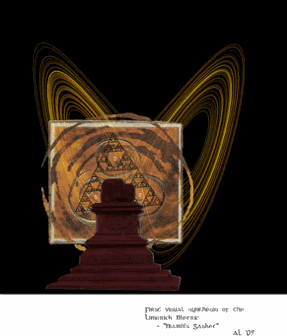
With specific relation to the “New Computer Science” and investigation of Australian Aboriginal Dreamtime models inspired a course of dialogue between myself and Alan that brought forward the the “Three Clock Paradigm” – the core paradigm of the New Computer Science. It holds that three clocks of different types running in the same vicinity can instantiate “Fertile Time” – just as the “World” is instantiated by the three nodes of the Dreamtime model. One of the most important properties of this “Fertile Time” space is the capacity for “creative evolution” within its bounds. Further radical properties are realized when two “Time Triangles” – two instances of Fertile Time overlap (i.e. in the case of a device running the “New Computer Science” and its user) – generating a “Star of David Effect” and the instantiation of the hexagonal “7-Space”… A higher synthesis…
From the point of view of my own research,”Niamh’s Gasket” is the most important as it represents best how I work – I tend to “see” the mathematics first and then apply extant or invented notation to render the vision in a mathematical expression.
META: Sie sagen, dass der Programmcode von heute immer noch den Traditionen der frühen modernen Mathematik folgt. Beziehen Sie sich auf Descartes?
META: You say that today’s program code still follows the tradition of early modern mathematics. Are you referring to Descartes?
AS: Was wir im Moment schon sagen können, ist, dass die neue Informatik eng, mit Kunst, Literatur, Psychologie, Musik, Tanz, Ökologie, Theologie, Mathematik, Quantenphysik, Geschichte und Grammatologie verknüpft sein wird. Der Beruf des Programmierers sollte von Grund auf neu definiert werden und diese Felder umfassen. Wir interessieren uns Insbesondere für die ästhetischen und soziologischen Dimensionen der Software. Und wir werden einen ganz neuen Ansatz wählen. Einen novel approach im wahrsten Sinne des Wortes (novel bedeutet im Englischen sowohl “neu” als auch “Roman”). Literatur und Leistung wird in der Neuinterpretation des Wissens, und im Softwarecode, eine wichtige Rolle zukommen.
AS: What we can say for now is that the New Computer Science, no longer an engineering and techie discipline, will be intimately related to art, literature, languages, sociology, psychology, music, dance, ecology, spirituality, theology, mathematics, quantum physics, history, semiotics, and grammatology. The profession of programmer should be redefined from the ground up to include these fields. We are especially interested in the aesthetic and sociological dimensions of software. And we will take a novel approach. Literally novel – literature, narrative, fiction, poetry, dramaturgy, and performance will all have an important status in the rethinking of knowledge, and in the software code, that is the New Computer Science.
AS: Und so bietet die neue Informatik, die auf der Grundlage der neuen Mathematik des 20. Jahrhunderts realisiert werden muss, eine alternative Antwort auf die Frage, wie wir mit dem Problem der Komplexität umgehen.
AS: The technology of resemblance to be realized on the basis of new 20th century mathematics (Gödel, Schrödinger, Riemann) provides an alternative answer to the question of how do we deal with the problem of complexity.
AS: Im bestehenden Computer-Paradigma werden komplexere Probleme in kleinere, besser zu lösende Teilstücke aufgebrochen. Das ist im Grunde die kartesische Methode von Descartes. Doch obgleich die kartesische Methode für mechanische System funktionieren mag, kann sie nicht von großem Nutzen sein, wenn wir etwas Lebendiges schaffen möchten.
AS: Within the existing computing paradigm, in order to deal with a complex problem, you break down the problem into smaller, more manageable parts. This is essentially the Cartesian Method of Descartes. But it is impossible to apply the Cartesian Method to quantum-mechanical generalized complementarities like the wave-particle duality or the Heisenberg Uncertainty Principle. Whereas the Cartesian method may work for mechanical systems, it cannot be of much use when we aspire to the creation of something that is living.
AS: Unser Ziel für die neue Informatik ist es, ähnlich wie in der Bewegung für künstliches Leben (Artificial Life), Software als halb-legendige Einheiten zu schaffen.
AS: Our goal in the New Computer Science, similar to the Artificial Life movement, is to create software as semi-living entities.
AS: Es wird Analogien oder Ähnlichkeiten zwischen der Software-Instanz und den Softwarekursen geben, in denen durch Baupläne die Grandlagen dafür bereitgestellt werden, was die Instanz kann. Die höchstrangige Analogie ist die Idee, dass die Software-Instanz eine Wahl hat, eine existenzialistische Freiheit, statt durch die in Vorlagen verfügbare Attribute und Daten bestimmt zu werden. Die Wahl wird durch die Unvollständigkeit eröffnet. Die Unvollständigkeit wird durch die Wahl eröffnet. Das ist es, was Alexis Clancy gesehen hat: ein göttliches Muster, durch die wahrnehmenden Medien wahrgenommen und als Textualität bekannt. Wir werden mit der Unvollständigkeit beginnen! Alexis und ich haben schon 22 konkrete Softwareentwicklungsprojekte definiert.
AS: The more correct approach corresponding to a breakthrough into 21st century science is to identify relationships of similarity, to find SAMPLES or PATTERNS that capture something of the vitality and complexity of the whole without breaking it down in a reductionist way.
We need a new technique that augments the inheritance mechanism of Object-Orientation. In addition to inheritance, we will have analogies or resemblance between the software instance and the “blueprint” software classes which furnish the possibilities of what the instance can do. The highest-order analogy, defining the base of operations of this subsystem, is the idea of the software instance having a choice, having existentialist freedom, rather than being determined by available template attributes and data. Choice is inaugurated by Incompleteness. Incompleteness is inaugurated by Choice. Choice is inaugurated by the Möbius Twist and the Aleph Operator. This is what Alexis has seen: a divine pattern perceived through the perceptual media known as textuality. Incompleteness is at the foundation of the architecture of a radicalized Object-Oriented class inheritance hierarchy. Whereas Descartes and Leibniz (before Deleuze wrote about Leibniz) in the 17th century wanted to deduce a system of knowledge starting from a few certainties (an axiom-based system), WE WILL START WITH INCOMPLETENESS (integrated at an axiomatic level).
Opposing components cannot be in the same place within the model in a given frame. In our frame, there exists, within the field, three further fields which lie outside of our understanding: the two “gaps” and the “jump.” These elements are strictly analogous to Incompleteness. Alexis calls this “Topographical Incompleteness.” If we decide to populate the “gaps” with some other, smaller potentialities, we will find the same thing within the frame again – more pairs of “gaps” – in a sense self-similar, or understood as “Fractal Incompleteness.” Voila.
META: Und indem wir Objekten, sozialen und technischen, die Wahlfreiheit lassen, entkommen diese rationalen Objekte der Logik der verdummten, passiven Konsumgesellschaft. Denken Sie, dass in dieser doppelten Bewegung eine emanzipative Kraft liegt?
META: In your early essay “Society of the Instance,” you express a fascinating thought: you say that object-orientated program languages like Java, for example, are the new “artificial languages” of seductive power – what Baudrillard would call a new system of virtualization. In addition, you equate software objects with physical and social objects that curiously “combine a Platonist ingredient (software classes equate transcendental signifiers) and a deconstructionist ingredient (the free floating signifiers, unending, undecidable, auto-referentially recursive discourse in the hierarchical, (de)instituting, subclassing chains).” This seems to explain the cultural logic of late capitalism, because you identify the late-capitalist mode of production with instantiation (creating an object of a class): a successor to alienation, reification, simulation, and the spectacle. In other words: the “rational” object escapes its own logic. By giving objects, social as well as technical ones, the freedom of choice, those “rational” objects escape the logic of dumbed-down passive consumerism? Do you think that in this double movement lies an emancipative power?
AS: Ja, natürlich denke ich, dass die platonische-dekonstruktivistiche Hybridität, die ich in “Society of the Instance” beschreibe, eine emanzipatorische Bewegung ist. Sie ist die Struktur der heutigen Ware-Form (commodity form) selbst und ihrer Umkehrbarkeit. Dies ist der Weg zur Wieder-Verzauberung (re-enchantment) der Welt, zum Rückgängigmachen der Entzauberung (disenchantment), der Bürokratisierung und dem eisernen Käfig der Rationalisierung, über die Max Weber gesprochen hat.
AS: Yes, of course I think that the Platonist-deconstructionist hybridity that I describe in “Society of the Instance” is an emancipatory movement. It is the very structure of the commodity-form today, and its reversibility. This is the path to the re-enchantment of the world, undoing the disenchantment, bureaucratization, and iron cage of rationalization that Max Weber talked about.
While I dislike Fidel Castro, he famously said: “La estoria me absolverá.” History Will Absolve Me. History will show that my essay “Society of the Instance,” which I wrote in 1998, and which was published in 2001, was the conceptualization of Artificial Intelligence. I am grateful to Pier Luigi Capucci of NOEMALAB.ORG, and also to Geert Lovink (NETTIME.ORG), for publishing “Society of the Instance.”
META: Wie stehen Sie zu technischen Implantaten und Klonen?
META: What’s your position on technological implants and cloning?
AS: Ich bin stark von der Cyborg-Theorie von Donna Haraway beeinflusst, einer feministischen Theorie. Wie in Star Trek muss das Leben keine biologische Grundlage haben, Ich habe keinerlei Probleme damit, technische Implantate in meinen Körper einpflanzen zu lassen, so lange diese wirklich für mich als Individuum hergestellt werden und ich nicht dasselbe Gerät bekomme wie zehn Millionen andere Menschen.
AS: I am very influenced by the cyborg theory of Donna Haraway, which is a feminist theory. As in Star Trek, life does not have to be biologically based. I am very happy to get technological implants in my body, as long as they are really designed for me as an individual, and I am not getting the same device as ten million other people.
AS: Ob ich für das Klonen bin? Das hängt davon ab, wer geklont wird. Bevor wir uns aber der Frage des biologischen Klonens widmen, müssen wir uns mit dem kulturellen Klonen befassen.
AS: Am I in favor of cloning? It depends on who is being cloned. Before we ask the question about biological cloning, we have to ask the question of cultural cloning.
AS: In Amerika haben die meisten Menschen das Ziel, so zu sein wie alle anderen. Sie möchten ein kultureller Klon sein, der auf einer Reihe von Modellen, Codes und Formeln basiert. Lassen Sie uns zunächst klarstellen, dass wir in einer Gesellschaft des kulturellen Klonens leben, bevor wir über das biologische Klonens sprechen. Ich bin absolut für das biologische Klonen, wenn die Menschen, die wir klonen, echte Individuen sind. Ich würde große Künstler, Wissenschaftler und Autoren klonen, die in ihrem Dasein eine wirklich wichtigen und wertvollen Wissens- und Erfahrungsschatz gesammelt haben. So können die Lebensprojekte dieser Individuen fortgeführt werden, selbst wenn sie Krebs haben oder etwas ähnliches.
AS: In America, most people have the goal just to be like everyone else, to be a cultural clone, based on a set of models and codes and formulae. This is the contemporary version of Tocqueville’s society of conformism. Let’s become clear first that we are living in a society of cultural cloning before we start to talk about biological cloning. I am totally in favor of biological cloning if the people who we clone are really individuals. I would clone great artists, great scientists, and great writers who really have an important and valuable body of experiences and knowledge in their Dasein. So the life projects of these individuals can be continued, even if they have cancer or something.
This position on cloning is shown very well in the recent science fiction film “Moon,” starring Sam Rockwell.
META: Do you agree with Paul Virilio’s critical view of contemporary telecommunications technologies as having a destructive effect on spacetime?
AS: One of the major developments in new technology at the moment is the ubiquitousness of cell phones and of personal digital assistants and iPads. I see this as a very negative development for us. It’s a form of self-surveillance and mutual surveillance, and it’s being done in the context of after September 11, where there is security paranoia about everything. The way that cell phones are being used is that my friends and family and co-workers are keeping track of me and keeping tabs on me all the time. Where am I right now? What am I doing? What am I thinking? Twitter and people reporting what they are doing in the course of a day. It’s coming to the point where there will be so much of this surveillance information available that anyone can find out where was I between noon and 2 pm the day before yesterday. No secret love affairs anymore.
META: What would hybrid love – love among the cyborgs and androids – look like?
AS: On polysexuality, I would ask the question what is sexual liberation, referring to works such as Marcuse’s Eros and Civilization. My position is that sexuality is a desire, not an identity. I think that this is consistent with Deleuze and Guattari’s Anti-Oedipus, with various science fiction utopian novels, with Haraway’s cyborg theory, and with Judith Butler’s Gender Trouble. How does the system, invented in the 1970s, of straight-gay-lesbian-bi-trans, hinder the sexual liberation of the majority? How can digital, virtual/real, and virtual reality technologies lead us more towards the perspective of desire? How is the majority already secretly resisting the commodity system (Baudrillard)?